A friend and his wife designated this year "The Year of the Holiday".
They have had a really bad couple of years. Both have been seriously ill and separately and together have been through the slow-burn anxiety of gruelling treatment.
Family events added to the difficulties, and things have been Tough. Yes, that's meant to be an upper-case T.
So the Year of the Holiday was part recuperation, part triumphant recovery, a sort of shaking a defiant fist at the Fates.
At the weekend we chatted on the phone. He was about to depart for holiday Number 4. (It could be Number 5 and it is only April.)
"It's exhausting, this Year of the Holiday," he said. "It's impossible being away all the time. We are never here. It's giving us headaches. There's no time to get out on the bike. There's no time to do anything."
At work, he was always Mr Drive. He is an achiever, and likes no moment to be unproductive. Now retired (whatever that means), he likes to makes sure his every day is an advance, and he even has targets for leisure activities.
He is usually purposefully blissed out on baking bread (an expert loafer in one sense at least), cycling, walking, growing things on his allotment and generally revelling in domesticity.
He has done the tough stuff. I am just hoping he will survive the well-intentioned riot of absence which is proving so much more taxing.
Monday, 11 April 2016

Saturday, 9 April 2016
Working against the grain
My grandmother died when she was 30, and my mother was 7. After that, my Mum was brought up largely by her grandmother, and owing to the confusion of generations, I thought this person was my own grandmother throughout childhood.
She was an interesting woman, and already ancient when I knew her. She was deeply religious, and gave me a Bible as a birthday present when I was 9. It was a very nicely produced book, but at the time I wanted something more in keeping with being 9.
Her religion was deeply ingrained in her. One of her favourite words - I loved it as a child - was 'tabernacle'. It always sounded like a part of a crane to me. I could almost feel her anguish at the thought of being resurrected as she was, and having to spend eternity with her wooden leg.
The wooden leg was a late addition. It was at best a little primitive, and while not exactly Long John Silver style, it did have a sort of gearstick arrangement to allow the knew to be bent while sitting. Naturally this was more intriguing than the Bible and 'tabernacle' together.
It always surprised me just how fast she could move, especially when angry, which seemed to be often when I was around.
Before the wooden leg, we often went to see her in her tiny terraced house in Bradford. Her sister had lived in the house for 50 years, and after my grandmother was widowed, they shared it. It was a one-up-one down back-to-back house with a tiny scullery and an outside loo. At the back lived the terrifying Mrs Crabtree who could kill at ten paces. I gave her a wide berth.
My grandmother's house was different from home. Bradford had - and has - unusually wide streets which made the place feel spacious. They were great for playing football or cricket, even though Grandma lived on a hill. There was a chip shop at the bottom of the road, where, as soon as you arrived in the queue, the trick was to yell 'Special !'. By the time you got watch the wrapping-in-newspaper stage at the front, your especially large chunk of fish was done to perfection.
A this stage, pre-wooden leg, the most intriguing thing about Grandma was her front door.
The door was painted to look like wood grain. You could feel the pattern if you ran your fingers over it. I think the original door must have been in bad shape. Someone had covered it with plywood and then a wood artist had carefully grained it to make it look like an expensive wood. It did not look like any wood I knew, though. It was rather yellow, and finished with a zillion coats of yacht varnish so that it glistened as if permanently wet.
It must have been all the rage as several neighbouring doors were finished in similar style.
What bothered me then - no idea why - was what the wood REALLY looked like underneath all that careful fakery.
Wood fakery is everywhere now. And not just wood fakery, of course, but marble fakery, stone fakery. Wooden wardrobes have a paper wood design fused to the chipboard, and laminate floors have wood grain to mimic no end of timber types. And house doors that look fielded and wooden are moulded and grained all in one process.
I do love wood. I have Aspergers so I am allowed to say that. Yes, I love wood. Real wood, however cheap, however unfigured.
This week I came across some shelves that were from a school originally. To brighten up the children's environment they had been grained a deep, dark brown. The graining had been quickly done with a comb, and it was a bit untidy, especially in the tricky corners.
I stripped them, planing off the grain finish and yellow base coat, to find that the real wood underneath the Sunday-best varnish had its own spectacular grain and character. One shelf was a piece of second-hand oak, straight-grained and clear. The rest of the timber was beautiful redwood with an exuberant and delightful grain. It felt as if all of a sudden, the shelves could breathe again, see daylight, feel the sunshine.
They were never grand, but they had been carefully made with good attention to detail. They were (and are) solid, functional, and by no means plain. They were just lovely, honest, unpretentious and hard-wearing shelves with their own unpainted beauty.
Here's what they looked like when they were done:


Carpenters hate painting things. Not because they are lazy, but because they love wood.
Incidentally, the wooden leg was an attractive shade of matt charcoal.
She was an interesting woman, and already ancient when I knew her. She was deeply religious, and gave me a Bible as a birthday present when I was 9. It was a very nicely produced book, but at the time I wanted something more in keeping with being 9.
Her religion was deeply ingrained in her. One of her favourite words - I loved it as a child - was 'tabernacle'. It always sounded like a part of a crane to me. I could almost feel her anguish at the thought of being resurrected as she was, and having to spend eternity with her wooden leg.
The wooden leg was a late addition. It was at best a little primitive, and while not exactly Long John Silver style, it did have a sort of gearstick arrangement to allow the knew to be bent while sitting. Naturally this was more intriguing than the Bible and 'tabernacle' together.
It always surprised me just how fast she could move, especially when angry, which seemed to be often when I was around.
Before the wooden leg, we often went to see her in her tiny terraced house in Bradford. Her sister had lived in the house for 50 years, and after my grandmother was widowed, they shared it. It was a one-up-one down back-to-back house with a tiny scullery and an outside loo. At the back lived the terrifying Mrs Crabtree who could kill at ten paces. I gave her a wide berth.
My grandmother's house was different from home. Bradford had - and has - unusually wide streets which made the place feel spacious. They were great for playing football or cricket, even though Grandma lived on a hill. There was a chip shop at the bottom of the road, where, as soon as you arrived in the queue, the trick was to yell 'Special !'. By the time you got watch the wrapping-in-newspaper stage at the front, your especially large chunk of fish was done to perfection.
A this stage, pre-wooden leg, the most intriguing thing about Grandma was her front door.
The door was painted to look like wood grain. You could feel the pattern if you ran your fingers over it. I think the original door must have been in bad shape. Someone had covered it with plywood and then a wood artist had carefully grained it to make it look like an expensive wood. It did not look like any wood I knew, though. It was rather yellow, and finished with a zillion coats of yacht varnish so that it glistened as if permanently wet.
It must have been all the rage as several neighbouring doors were finished in similar style.
What bothered me then - no idea why - was what the wood REALLY looked like underneath all that careful fakery.
Wood fakery is everywhere now. And not just wood fakery, of course, but marble fakery, stone fakery. Wooden wardrobes have a paper wood design fused to the chipboard, and laminate floors have wood grain to mimic no end of timber types. And house doors that look fielded and wooden are moulded and grained all in one process.
I do love wood. I have Aspergers so I am allowed to say that. Yes, I love wood. Real wood, however cheap, however unfigured.
This week I came across some shelves that were from a school originally. To brighten up the children's environment they had been grained a deep, dark brown. The graining had been quickly done with a comb, and it was a bit untidy, especially in the tricky corners.
I stripped them, planing off the grain finish and yellow base coat, to find that the real wood underneath the Sunday-best varnish had its own spectacular grain and character. One shelf was a piece of second-hand oak, straight-grained and clear. The rest of the timber was beautiful redwood with an exuberant and delightful grain. It felt as if all of a sudden, the shelves could breathe again, see daylight, feel the sunshine.
They were never grand, but they had been carefully made with good attention to detail. They were (and are) solid, functional, and by no means plain. They were just lovely, honest, unpretentious and hard-wearing shelves with their own unpainted beauty.
Here's what they looked like when they were done:


Carpenters hate painting things. Not because they are lazy, but because they love wood.
Incidentally, the wooden leg was an attractive shade of matt charcoal.
Friday, 8 April 2016
Storms
My home as a child was the end shop in a terrace of five.
We didn't have much of a garden at the back of the house, and it was an annual excitement when my Dad decided the time had come to ready the hanging baskets.
My Dad would probably have enjoyed gardening if he had had more time and two arms, but as he had little of the former and only one of the latter, the hanging baskets were the farthest reach of his green(ish) fingers.
The baskets hung at either side of the shop door, and were on pulleys so that they could be lowered for watering. They were richly colourful and seemed special and exotic to me at the time.
Childhood memories often seem to be of endless sunny days: playing out until someone ran out of patience and came to call you in. There were plenty of summer days for me, but I remember storms better than happy days of sharp-shadowed mischief.
We lived half way down a very long hill, on a road that ran along its contours. When it rained, water heading downhill took a break on our road, and raged along the gutter, trying to find the way down. To a child, the speed and suddenness of our river was always impressive, along with its equally rapid disappearance and the pavements gently steaming.
In summer, the shop door was always open, and when there was heavy rain my Dad would stand in the doorway, resting his right shoulder on the jamb, stretching out his left arm to the left jamb, and crossing his ankles. It was a really characteristic pose, and in my mind's eye I can see him now so clearly. He's be wearing his usual ill-fitting Blanchard's jacket, a flat cap on his head and a cigarette danging from his lips.
In the space beneath his outstretched arm I would stand and we would watch the storm. With luck there might be lightning, but the big attraction was the rain. We did not talk, but watched the river rise and fall, smelled the fragrance of the baskets, sometimes counting the gap between the lightning and the thunder to figure out how far away the storm was, and which way it was moving.
I loved those storms, and love them still. I stand in my doorway and watch them roll across the fields, count the gap, gasp at the stabs of light. Though my father is long, long gone I am always somehow right back under his outstretched arm, waiting for the scent of warm wet earth.
We didn't have much of a garden at the back of the house, and it was an annual excitement when my Dad decided the time had come to ready the hanging baskets.
My Dad would probably have enjoyed gardening if he had had more time and two arms, but as he had little of the former and only one of the latter, the hanging baskets were the farthest reach of his green(ish) fingers.
The baskets hung at either side of the shop door, and were on pulleys so that they could be lowered for watering. They were richly colourful and seemed special and exotic to me at the time.
Childhood memories often seem to be of endless sunny days: playing out until someone ran out of patience and came to call you in. There were plenty of summer days for me, but I remember storms better than happy days of sharp-shadowed mischief.
We lived half way down a very long hill, on a road that ran along its contours. When it rained, water heading downhill took a break on our road, and raged along the gutter, trying to find the way down. To a child, the speed and suddenness of our river was always impressive, along with its equally rapid disappearance and the pavements gently steaming.
In summer, the shop door was always open, and when there was heavy rain my Dad would stand in the doorway, resting his right shoulder on the jamb, stretching out his left arm to the left jamb, and crossing his ankles. It was a really characteristic pose, and in my mind's eye I can see him now so clearly. He's be wearing his usual ill-fitting Blanchard's jacket, a flat cap on his head and a cigarette danging from his lips.
In the space beneath his outstretched arm I would stand and we would watch the storm. With luck there might be lightning, but the big attraction was the rain. We did not talk, but watched the river rise and fall, smelled the fragrance of the baskets, sometimes counting the gap between the lightning and the thunder to figure out how far away the storm was, and which way it was moving.
I loved those storms, and love them still. I stand in my doorway and watch them roll across the fields, count the gap, gasp at the stabs of light. Though my father is long, long gone I am always somehow right back under his outstretched arm, waiting for the scent of warm wet earth.
Wednesday, 6 April 2016
Maximum living wage
The minimum living wage is here. Too low, rather late, and with the promise of better by 2020, it is at least here. And with it comes the hope that those on the lowest wages may at last get a fairer share of the wealth they create. Not a fair share, but a fairer share.
Sadly, some employers are already complaining that they cannot afford to pay the new minimum living wage, while others are reducing hours to ensure that the cost of employment remains the same, even if the minimum living wage means that they have to up their game.
I can't avoid feeling irritation: do these employers not recognise that their argument is based on the assumption that their workers should not only give their sunny days to the company, but also subsidise its bottom line by accepting poor pay ?
Sadly, the minimum wage will not help close the inequality gap which flourishes in the UK. The distance between the top earners and the ordinary workers remains vast and is getting worse.
The Panama Papers remind us of what we already know, but try to block out of our minds: that society is governed in the interests of the very wealthy, and the very wealthy intend to stay that way by avoiding and evading tax in any way which keeps them on top.
Perhaps the minimum wage is a sop to distract us from the intolerable inequality which nobody wishes to address.
It is almost impossible to figure out how families manage where the minimum living wage is their sole source of income. And it is equally impossible to imagine what the very wealthy do to earn their vast salaries and bonuses.
Maybe if we are serious about equality we ought to embrace the minimum living wage and introduce a maximum living wage.
It ought to be possible for a bunch of economists to figure out what figure constitutes the maximum that could reasonably be needed. The maximum living wage would not limit earnings. It would merely establish that the maximum which an individual could earn would be fixed - say at the level of the average house price, currently £220k. Above that, all earnings - not a fraction, but the whole - would automatically be paid into a fund for public services.
If the very rich wished to increase their earnings, they could add to the basic maximum by working for the community at the rate of the minimum living wage.
The maximum living wage would benefit both rich and poor alike: public services would be well funded, and all could benefit from them. The rich would avoid the public opprobrium which accompanies their stellar salaries. And the poor would have the security of knowing that the country had first-class public services.
If the government was serious at all about equality, it would look at rigorous ways of re-distributing wealth. The minimum wage does not even begin to tickle the surface, never mind scratch it. The maximum living wage might be a better start.
Lots of people might want to stockpile very large piles of money. The biggest change brought about by the maximum living wage would be that we would begin to consider what people needed rather than what they wanted.
We live today in the fifth largest economy on the planet. We have shrinking public services, an underfunded NHS straining under the demands placed on it, and educational internment which gives back very little for the years of childhood it steals. That ordinary people do not reap the benefit of national economic success screams at you. There are growing numbers using food banks, swelling numbers of homeless, and mental health services which would shame a banana republic.
All this needs to change. We need Government as if people matter, and we need to respect and reward those who really create the wealth.
The maximum living wage would be a good start.
Sadly, some employers are already complaining that they cannot afford to pay the new minimum living wage, while others are reducing hours to ensure that the cost of employment remains the same, even if the minimum living wage means that they have to up their game.
I can't avoid feeling irritation: do these employers not recognise that their argument is based on the assumption that their workers should not only give their sunny days to the company, but also subsidise its bottom line by accepting poor pay ?
Sadly, the minimum wage will not help close the inequality gap which flourishes in the UK. The distance between the top earners and the ordinary workers remains vast and is getting worse.
The Panama Papers remind us of what we already know, but try to block out of our minds: that society is governed in the interests of the very wealthy, and the very wealthy intend to stay that way by avoiding and evading tax in any way which keeps them on top.
Perhaps the minimum wage is a sop to distract us from the intolerable inequality which nobody wishes to address.
It is almost impossible to figure out how families manage where the minimum living wage is their sole source of income. And it is equally impossible to imagine what the very wealthy do to earn their vast salaries and bonuses.
Maybe if we are serious about equality we ought to embrace the minimum living wage and introduce a maximum living wage.
It ought to be possible for a bunch of economists to figure out what figure constitutes the maximum that could reasonably be needed. The maximum living wage would not limit earnings. It would merely establish that the maximum which an individual could earn would be fixed - say at the level of the average house price, currently £220k. Above that, all earnings - not a fraction, but the whole - would automatically be paid into a fund for public services.
If the very rich wished to increase their earnings, they could add to the basic maximum by working for the community at the rate of the minimum living wage.
The maximum living wage would benefit both rich and poor alike: public services would be well funded, and all could benefit from them. The rich would avoid the public opprobrium which accompanies their stellar salaries. And the poor would have the security of knowing that the country had first-class public services.
If the government was serious at all about equality, it would look at rigorous ways of re-distributing wealth. The minimum wage does not even begin to tickle the surface, never mind scratch it. The maximum living wage might be a better start.
Lots of people might want to stockpile very large piles of money. The biggest change brought about by the maximum living wage would be that we would begin to consider what people needed rather than what they wanted.
We live today in the fifth largest economy on the planet. We have shrinking public services, an underfunded NHS straining under the demands placed on it, and educational internment which gives back very little for the years of childhood it steals. That ordinary people do not reap the benefit of national economic success screams at you. There are growing numbers using food banks, swelling numbers of homeless, and mental health services which would shame a banana republic.
All this needs to change. We need Government as if people matter, and we need to respect and reward those who really create the wealth.
The maximum living wage would be a good start.
Saw table
Table saws are a much better way to cut straight and to a fixed width than a hand-held circular saw, even with a guide attached.
My table is a bit brutal. It gets the job done, but it isn't at all sophisticated. But then neither am I.
This is it. Its key selling point was that it was always so robust. It has taken a lot of hammer.

The problem in the picture is that there is a large rectangular hole where the saw blade comes through. An insert fits into the hole, and is dead flush with the surface. But the insert with this table was made of plastic. Plastic ? Yes, that's right. What were they thinking ?
The plastic broke, and replacements are not available as the table is too old. (But then again... )
 I made a replacement from some oak, but it was too floppy as the thickness is limited to 2.5 mm. The oak worked but it was clearly going to be temperamental. It's in the middle here, with the broken plastic one at the left.
And on the right (da dah !) is the one I faffed around with most of yesterday. It's aluminium. Metalwork is definitely not my bag of bananas: hence all the faffing. But the thing works, and actually works a lot better than the original.
 One thing it does more efficiently is resist the pressure from the saw's spring-loaded blade guard. It always tended to push the plastic insert upwards slightly. This one shrugs off the pressure.
It was a relief when the thing fitted. My usually style is to accidentally cut off the last nib by mistake with the thing 97% complete...
My table is a bit brutal. It gets the job done, but it isn't at all sophisticated. But then neither am I.
This is it. Its key selling point was that it was always so robust. It has taken a lot of hammer.

The problem in the picture is that there is a large rectangular hole where the saw blade comes through. An insert fits into the hole, and is dead flush with the surface. But the insert with this table was made of plastic. Plastic ? Yes, that's right. What were they thinking ?
The plastic broke, and replacements are not available as the table is too old. (But then again... )

And on the right (da dah !) is the one I faffed around with most of yesterday. It's aluminium. Metalwork is definitely not my bag of bananas: hence all the faffing. But the thing works, and actually works a lot better than the original.

It was a relief when the thing fitted. My usually style is to accidentally cut off the last nib by mistake with the thing 97% complete...
Tuesday, 5 April 2016
Serendipity
Serendipity.
I like it. Like the word and like what it is.
Sometimes you just stumble across something that feels so perfect and whispers to your soul. Something you never expected, were not looking for, didn't know existed.
The net makes chance finds like this so much easier. Maybe serendipity is not so much a peripheral attribute of the net, but right at its core.
Anyway, reading my book on India has been a revelation.
I had not heard of Amrita Sher-Gil and met her in the book. She was India's most celebrated woman artist of the last century, and died in her late 20s.
Her chapter is illustrated by a terrible reproduction of one of her works, the Haldi Grinders. It looks like this:

I had to search for a better reproduction and found one:

But searching for this one picture opened a door onto an unknown gallery of such visceral power. I am not a massive fan of painting, but her pictures, all painted at such a young age, just spoke to me. They are diabolically good, by which I mean that they seem so impossibly brilliant that they feel almost like some kind of black magic.
Yes, they speak to my soul. This woman, Amrita Sher-Gil was never painting for a simple photographic reality. She saw something in her subjects, something hidden within, and expressed that. Fleeting moments that catch something central to being, central to living.

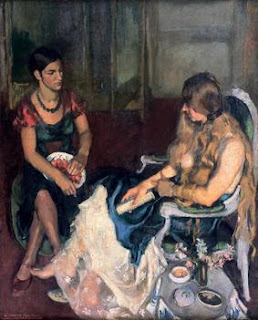
Serendipity may feel trivial, random, mere chance. But sometimes chance encounters can change your life. Thanks to Amrita Sher-Gil I am richer than I was.
I like it. Like the word and like what it is.
Sometimes you just stumble across something that feels so perfect and whispers to your soul. Something you never expected, were not looking for, didn't know existed.
The net makes chance finds like this so much easier. Maybe serendipity is not so much a peripheral attribute of the net, but right at its core.
Anyway, reading my book on India has been a revelation.
I had not heard of Amrita Sher-Gil and met her in the book. She was India's most celebrated woman artist of the last century, and died in her late 20s.
Her chapter is illustrated by a terrible reproduction of one of her works, the Haldi Grinders. It looks like this:

I had to search for a better reproduction and found one:

But searching for this one picture opened a door onto an unknown gallery of such visceral power. I am not a massive fan of painting, but her pictures, all painted at such a young age, just spoke to me. They are diabolically good, by which I mean that they seem so impossibly brilliant that they feel almost like some kind of black magic.
Yes, they speak to my soul. This woman, Amrita Sher-Gil was never painting for a simple photographic reality. She saw something in her subjects, something hidden within, and expressed that. Fleeting moments that catch something central to being, central to living.


Serendipity may feel trivial, random, mere chance. But sometimes chance encounters can change your life. Thanks to Amrita Sher-Gil I am richer than I was.
Friday, 1 April 2016
Coal hole
No wonder English is so hard to spell. Coal hole. Even I can see there's something wrong there.
And there was something wrong yesterday morning when bloganonymous Sheffield son went to out to work and discovered that his coal hole cover had disappeared overnight. He thought scrappers: I thought break-in. But either way it had gone, leaving a large hole in a dark passage to snap legs of postmen, neighbours, and friends. And maybe even swallow up the odd over-curious cat.
I rang BSS's partner who was unfazed, Actually she is super-smart and unfazed by anything, and I mean anything. She went out to measure and came back with a precise set of measurements and a complete description of the aperture, leaving me to cut steel with confidence.
And this is me cutting the steel with confidence and an angle grinder.


When I arrived with the new cover, super-smart partner had already fitted a chopping board with a plant pot on top for decorative effect. Thanks to S-SP's measurements, the thing fitted perfectly. And it reminded me of a childhood song in Sheffield:
And there was something wrong yesterday morning when bloganonymous Sheffield son went to out to work and discovered that his coal hole cover had disappeared overnight. He thought scrappers: I thought break-in. But either way it had gone, leaving a large hole in a dark passage to snap legs of postmen, neighbours, and friends. And maybe even swallow up the odd over-curious cat.
I rang BSS's partner who was unfazed, Actually she is super-smart and unfazed by anything, and I mean anything. She went out to measure and came back with a precise set of measurements and a complete description of the aperture, leaving me to cut steel with confidence.
And this is me cutting the steel with confidence and an angle grinder.


When I arrived with the new cover, super-smart partner had already fitted a chopping board with a plant pot on top for decorative effect. Thanks to S-SP's measurements, the thing fitted perfectly. And it reminded me of a childhood song in Sheffield:
We're rate daarn in't coil oil where t' muck slarts on't winders.
We've used all are coil up an' we're rate daarn t't cinders.
When't bum bailiff comes 'e won't know where t' find us,
Cos we're rate daarn in't coil oil where t' muck slarts on't winders
Subscribe to:
Posts (Atom)