Tuesday, 7 June 2016

If this isn't nice, what is ?

Bloganonymous daughter gave me this chunk of spalted beech today.


If there is a more delicious wood, tell me what it is.

This chunk is an off-cut, and not a lot of use. You can see that it is part of a roundel cut from the log across the heart of the tree. The heart is right at the top of the picture. And you can see the shakes that are splitting the piece as it dries.


But just look at that grain. Isn't it just amazing ? 

Spalted beech is just standard beech that has been affected by a fungal growth which gets right through the tree and puts that stunning marking into the wood. 


It's tricky wood to work, and the light and dark parts tend to be different in terms of hardness. In this case the lighter areas are pretty soft.


This chunk is beautiful. At least I think so. My plans ? Well, I think I will smooth it down to make if feel like silk, and maybe wax the end result. Wood like this does make you want to touch it, stroke the grain.

Watch this space.

Seize the day


Carpe diem. Seize the day.

When Horace, and, later, Martial, shared the same obsession, life expectancy was much lower than now, and the majority of Romans died in their prime, long before what we would consider old age. Life was uncertain. Famine, war, disease all came unexpectedly and seemed unstoppable.

All the more important, then, to make sure that every hour was packed with 60 minutes of living. Not for them the dull satisfaction of existing. They had an urgency which isn't uncomfortable today.

Neither Horace nor Martial felt that he wanted to bet too firmly on tomorrow, and did not want to postpone experience, achievement, friendship, pleasure.

This particular carpe diem hangs in my hall. It's a great reminder (if I needed one !) that life is short, and time is not there to waste. Larkin talked of the 'forgotten boredom' of his childhood, and later of 'time torn off unused', and he fervently wished to avoid both.

I wasted too much of my life on the illusion of achievement at work, and not enough on the reality of living a joyful life.

Carpe diem reminds me that enough is enough. Wasting days is a luxury I can no longer afford (if I ever thought I could). 'As if', said Thoreau, 'you could kill time without injuring eternity.'

Exactly so.


Monday, 6 June 2016

Birdsong today

Last night was really warm here, and for the first time this year all the windows were open all night.

Result ?

This morning I was woken by massed birdsong. There were more birds than I could possibly count, some calling, but most singing.

For me the glorious liquid bubbling of the blackbird is magical.

But amongst this morning's orchestra the call of the local finch cut through the rest. Two notes, repeated endlessly, with all the charm of a rusty hinge. The finches drive me nuts every year with their iterative lack of ambition.

But what they lack in melody they make up for with sheer energetic and enthusiastic determination. Finches may not have the most engaging song, but nobody can fault them for effort. And for some reason it does cut through the rest and stand out in the rising light.

Oddly, the singing this morning made me think of Larkin's gloomy Aubade, one of my all-time favourite poems. His "soundless dark" brought him no birdsong to disperse his anxieties, and to remind him that life continues vibrantly even after our own small demise.

It made me think, too, of my tutor at university, J H W G Liebeschuetz, a man of vast beaming geniality and warm, though puzzled, humanity. I think his air of slight and infinitely kind bewilderment must have come from wondering how his students could cope with having such small brains. He was a blackbird trying to teach finches.

Sunday, 5 June 2016

A plague on both their houses

I have given up on the European debate.

Or at least I had given up until yesterday when Martin Kettle cheered me up in the Guardian. I found I could disagree with him only on Jeremy Corbyn. Jeremy is in grave danger of making me thnk that politics might work. I like him a lot.

But read what Martin Kettle had to say about our politicians and be prepared to polish up your nodding skills.

He might have added (why didn't he talk to me before writing ? Hah !) that it is our mad adversarial 'system' of political debate which has led to a campaign of obfuscation, mud-slinging, ad hominem attacks, and far more heat than light.

At the end of this shabby, squalid, unworthy debate will the politicians review and regret the way they ran it ? The way they shafted the electorate ? Again ? Not a bit of it. The winning side will crow and assert that it was their arguments which prevailed with the Bristish people. That's pretty sad, I think.

I also wonder what out European friends think of this strident tirade of insults. It is almost like rowing about someone while they are still in the room, as if they cannot hear.

Sigh.

Reforming Europe ? I had rather hoped that Europe might reform us. 

It'll be a big job: our politicians are clearly in need of a lot of work. 
 

Life in a bunch of objects

The Telegraph runs an occasional column where people use objects to illustrate their lives. It's called "My Life in Eight Objects" - or however many they have chosen. The actual number seems to range from a brisk seven to eleven for the indecisive.

I liked this recent effort by Simon Callow.

Some people use objects to sketch a trajectory through time, and choose things that transport them to past experiences. Others choose objects relevant in the immediate present.

It's a bit like a Desert Island Discs of Things.

It got me thinking and seemed like a fun thing to do. You don't need to be famous to wonder which objects somehow speak about your life. My problem is that I am not really into possessions and don't really buy a lot of stuff: I like things that are useful of beautiful or both. I do pick up junk in the same way my jumper picks up fluff, and I cannot bear to throw anything out.

Oh dear. Anyway, here goes.


This little block plane is a gem and something that should have been in my toolkit years ago, decades ago. It fits snugly in your palm, is unbelievably sharp, and cuts cleanly even across the end-grain. It is just a laughing joy to use, and it does so many jobs. It also makes a soothing swishing noise.


I have eaten yogurt for forty years or so, and it is the main staple food here at the Mansions. No meal is really a meal without yogurt. If I could, I'd eat nothing but yogurt. Nothing beats Longley Farm, but Sainsbury's have the best deal around at the moment.


This is my Gibson guitar which I bought after my mother died in 1973. The fingerboard is hollowed out between the frets with constant playing. I play every day on it, and it has been an outlet for every kind of mood. Its voice has mellowed over the years, and so have I. This guitar isn't as slick as modern guitars, but it does sing so well.


It feels shaming to have a computer on the list. But I spend a lot of time with it, researching family trees, and especially mailing. It has a white cardboard hood because it is black, and Aspergers make me unable to tolerate black in large areas. It just makes me jumpy. The white cardboard works a treat. The computer needs a much overdue update.


These are Dickies dungarees, and they do not mind if you treat them like this. Dickies make my favourite clothes: tough, uncompromising, and able to shrug off stains. They are so comfortable to wear and very forgiving. Did I mention that they seem to last forever ? They are really useful and in winter I wear them almost constantly.


Shorts. What would I do without shorts ? They are what I wear between April and October. (Different, clean pairs, obviously.) My legs like the freedom and wonder what happened to the light when I have to put on trousers now and then. Most of my shorts are violently striped and have to be kept well away from the camera. They do not need the air of publicity. These are slightly more restrained.


Hello Catullus. He has been a friend for life. At least it seems that way. When I first went to university, and went to the local bookshop clutching my reading list, Catullus was the first book I bought for the course. Or rather, my father bought it for me. It was the wrong edition. Neither of us knew then that Catullus would become a life-long passion. I read him at least three times a week, and have done for nearly fifty years now. I learn something new every time. I love the emotional directness, and I adore the feeling that you can hear real Romans talking in some of the poems. It is time travel and emotional intelligence in just the one book.


And this is my copy of T S Eliot's Collected Poems. At university I was Obsessed (capital O) with Eliot and carried this book around like a Linus blanket. It went everywhere with me, and was never out of my sight except when I was actually asleep. It battered now, and is my most-travelled book. Eliot's magic still remains, though the obsessive quality of my love of his thinking has faded. As a young man, the Waste Land spoke to my condition, but latterly it is the beauty of the Four Quartets which has continued to entrance me.


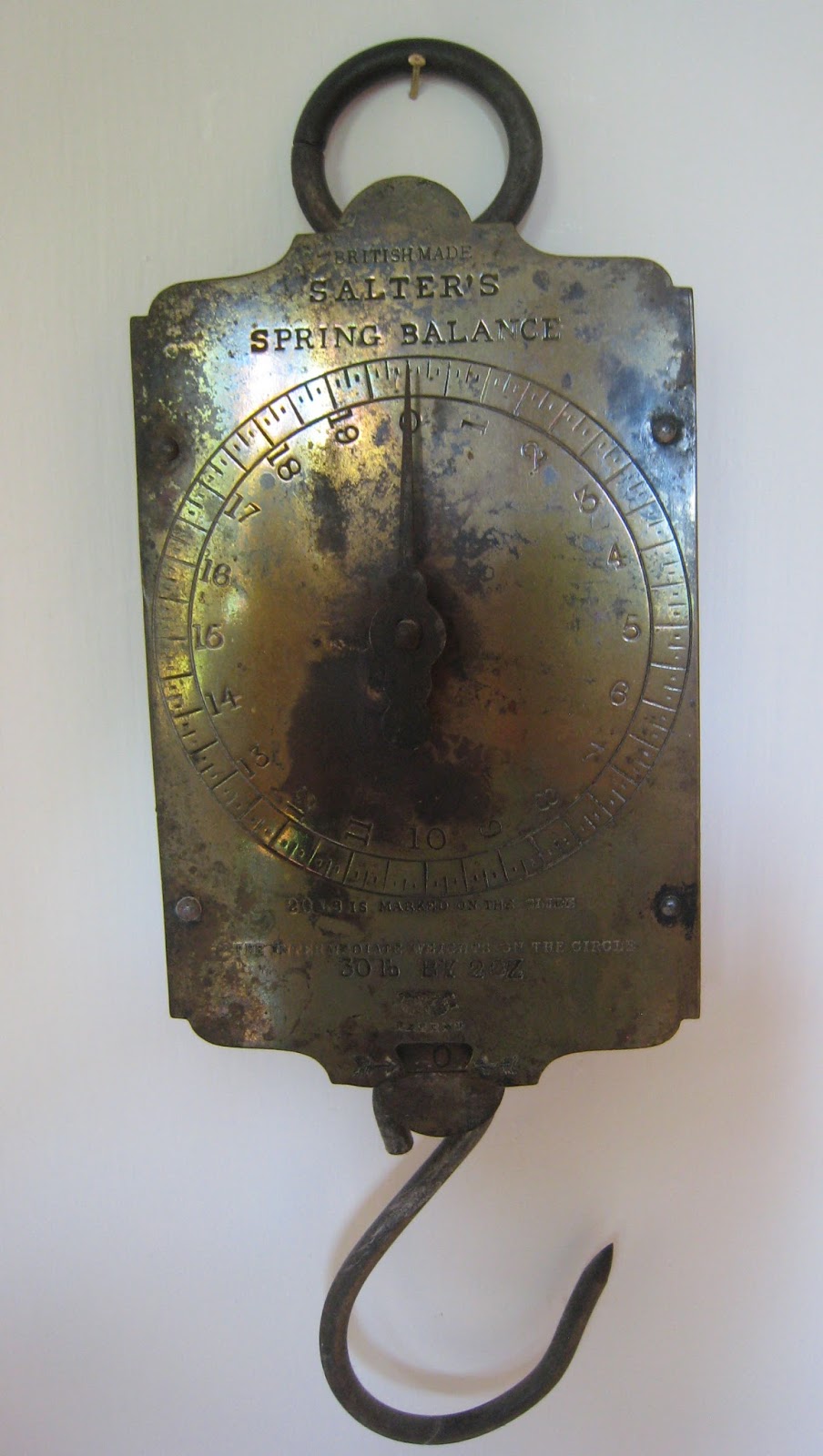
And this is my father's spring balance. He used it most days, and it is the only thing I have of his. The balance was lost in a fire, and was badly damaged and blackened when I dug it out of the ashes. It was expertly and sensitively restored by Salters completely free of charge. It's face needs re-coating, but I think it is fine the way it is. It lives in the kitchen and though I do not use it often, I enjoy its presence.

The last object is my bike. Not really my bike, but almost any bike. My current bike is not my favourite and was a huge mistake. But bikes have been a vast and important part of my life and no day feels complete without riding one. I get jumpy if I do not ride, and, like music, bikes have rescued me so often. Tandems, trailers, side-by-sides, road bikes, mountain bikes: all have helped me bliss out.

Hmmm.

Wonder if I would pick the same objects tomorrow ? For sure.

PS I got a comment which Blogger would not put up for some reason. It was this:


Oh I love this post. It really is you. I don't think I could do this, as I don't think I am attached to anything like you are. Except one of my mum's fleece green jackets that I wear often. It just gets me feeling close to her. Second would be a special ring that I wear all the time.


Saturday, 4 June 2016

Occam's razor


Entia non sunt multiplicanda praeter necessitatem

Things should not be complicated except by necessity


That is, keep things simple. 

It works for me.


Wabi-Sabi

An artist whose work I admire introduced me to the concept of Wabi-Sabi. A lot of her work is around Wabi-Sabi principles, and she lent me a book by Leonard Koren: Wabi-Sabi for Artists, Designers, Poets & Philosophers.

What I needed really was Wabi-Sabi for Practical Yorkshiremen with Aspergers, but Leonard hasn't got round to that yet, so that book will have to do.

Basically, and clearly I am no expert, Wabi-Sabi is about the beauty found in impermanence, imperfection and incompleteness. In practice it is about rough edges, loose ends, intriguing gaps, and small Islamic errors, maybe the errors of nature.

Leonard Koren tells me it is loosely aligned with Zen Buddhism, but as far as I can see, it is much more to do with entropy and science around us.

Interestingly, one my friend's clients needs a plinth for a sculpture, and I am about to make it. What I do is never art, of course, but even at this level small imperfections are not to be welcomed. No good having the plinth wonky or with a chunk out of the bottom. Because it is to showcase a sculpture on the top, the plinth must have a sort of seamless invisibility. If anyone notices the plinth, it will have failed. The plinth should not be the centre of even fleeting attention. It is the lift-attendant of the art world.

I am trying to think of how Wabi-Sabi might influence my plinth, and am in danger of getting splinters through scratching my head.

Wabi-Sabi feels to me to have much in common with Dadaism, with found art, and I love the idea that there should be nothing there which is not necessary to the structure of an object. This shouts at me that it is the un-ornamented structure itself which is inherently beautiful.

Wabi-Sabi is no more than Occam's razor slashing at artistic endeavour. I love the idea that the best solution to a problem is often the most elegant, the most beautiful, the least baroque. It works for maths, it works for problem-solving generally. Why shouldn't it work for art, too ?

I have to admit that Japanese culture feels psychologically alien to me, and I am much more a sucker for personal development and self-realisation than for taking my place in an honorific hierarchy. But Wabi-Sabi does seem to chime with Thoreau's love of nature, his deeply unsentimental attachment to growth, blooming and decay.

Maybe the spare beauty of invisibility is a good thing. Maybe that's the lean goal for the plinth.

Watch this space. (Not that you will see anything in it.)